
In my search for a metaphor that could make sense of the federated chaos that defines digital governance today, I turned first to my favorite heist and action films, stories where teams of specialists come together for impossible missions.
Ocean’s Eleven is tight friends. Fast and Furious talks “family,” but that’s not real transformation.
The Heist had strangers forced together ended in mistrust. I almost lost hope before I thought of The Avengers: flawed heroes united by one urgent mission. Messy, but effective.
Digital transformation isn’t perfect process; it’s Nick Fury assembling chaos.
Governance frameworks promise neat roles but ignore the real struggle: power, trust, fear. It’s not control versus autonomy, it’s pretending alignment comes from frameworks alone.
Assembling the Digital Avengers When Governance Goes Rogue
Picture this: you’re the new Chief Digital Officer, buzzing with energy and frameworks, even named your AI assistant “Jarvis.” You’re ready to assemble your Avengers, cross-functional teams on a bold digital mission: cloud-native, AI-first, federated data ownership, and smooth governance. You swagger in like Nick Fury, promising power and unity.
Fast forward three chaotic months: marketing launches a GPT chatbot without security checks, finance builds secret pipelines, each team runs their own agenda, IT feels ignored, legal is freaking out, and the CEO’s breathing down your neck for results.
Welcome to The Governance Game.
Nick Fury had SHIELD, an empowered, credible force; you? Probably an underfunded and over blamed central team. Frameworks say “empower federated teams,” but no one agrees on what that really means. Everyone wants freedom, no one wants messy governance, and most federated squads think someone else handles data hygiene. The real question isn’t “centralize or federate?” but “where are we pretending we’ve decided, but actually haven’t?”
Frameworks skip over messy realities, assuming coordination will just happen. Spoiler: it won’t and that’s why governance can kill a CDO’s career.
Why frameworks fail
Lets review governance and operating model frameworks before going to next layers. If you look at SAFe, ITIL 4, TOGAF, DAMA or Data Mesh, they bring one specific set of lens to the operating model and governance and create a lot of blind spot for Chief Digital Officer to navigate.
But here’s the catch: while these frameworks provide valuable foundations, they often leave critical blind spots, especially for Chief Digital Officers navigating complex, fast-changing environments.
No single framework fits all. Your enterprise context is unique, and what works best is often a tailored approach, or even a hybrid model, designed to align with your organization’s specific needs, culture, and maturity.
While frameworks are useful, I often feel that the core three dimensions of federation versus centralized thinking are rarely discussed or even brought to the table. Lets evaluate a simplified view those dimensions.
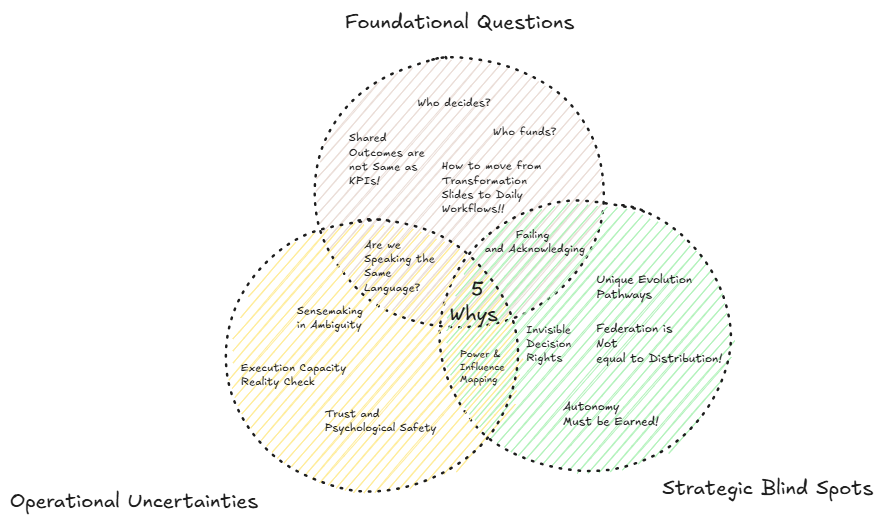
Foundational Questions
We know these matter. Yet they often stay unclear.
Who actually decides?
→ Decision-making needs clarity. Know where advice stops and authority begins.
Who pays for what?
→ Funding rules must be explicit. Vagueness here breaks trust fast.
What outcomes unite us?
→ Local KPIs are fine, but shared value needs shared goals.
Is governance part of our daily work?
→ If it only lives in slides, it’s not real.
Have we planned to fail?
→ Failure is inevitable. Confusion isn’t, if we prepare.
Operational Uncertainties
These often go unnoticed until they slow us down.
Are we culturally ready?
→ Technology is the easy part. Leadership mindset and change readiness matter more.
Where does influence really lie?
→ Org charts show structure, not power. Map the real dynamics.
Do we have the capacity to deliver?
→ Ambition must meet actual capability and constraints.
Are our feedback loops fast enough?
→ Learning velocity is a leadership advantage.
Can we navigate ambiguity?
→ Governance must help decode fuzziness, not freeze in it.
Is ethical thinking built in?
→ Governance must embed responsibility from the start, not after.
Are we building trust?
→ Fear-based compliance doesn’t scale. Psychological safety does.
Can we tell the full story of value?
→ KPIs don’t inspire , stories do.
Strategic Blind Spots
These are the blind spots we don’t even know to look for.
Why are we federating (or centralizing)?
→ Structure should follow intent, speed, value, or risk. Start there.
Where are the maturity guardrails?
→ Autonomy without earned trust creates chaos.
Are we truly federated or just scattered?
→ Federation requires shared standards, not just distributed ownership.
Who connects the dots?
→ Translators, curators, and trust brokers are essential, yet often unnamed.
Are decision rights visible?
→ Standards, exceptions, and budget paths need to be clear and codified.
Can our model evolve?
→ Good models flex. Great ones survive drift, crisis, and growth.
Is trust designed into the system?
→ Rituals, recovery playbooks, and joint wins matter more than rules.
Do we enable learning across silos?
→ Federated teams must learn together, or they’ll just repeat mistakes in isolation.
Final Thought: If Your Governance Model Can’t Survive a Chatbot…
These three dimensions above☝️ are only scratching the surface of what digital transformation truly demands.
Interestingly, many of these elements naturally surface in complex city or ecosystem transformation projects, where you’re often prepared upfront to navigate multiple layers of stakeholders, governance, and accountability.
The real challenge comes when we step into digital transformation initiatives assuming those dynamics won’t apply, especially in corporate environments. But more often than not, they do.
If HR’s weekend GPT experiment catches you by surprise, it’s probably not about overreach — it’s more about the quiet gaps in ownership, funding clarity, and shared accountability.
As a CDO, your role isn’t to have all the answers or wear a cape — it’s to build trust and structure in the middle of complexity.
It’s not about choosing sides between centralization and federation.
It’s about making decision paths, power structures, and budget flows visible and fair — and ideally, a little less mysterious than your average fantasy drama.
Because in most transformations, it’s not flawed strategy that derails progress…
It’s the illusion of alignment, and yes, sometimes the surprise AI pilot too. 🙂